What the Hack?
UT PGE’s second annual Energy AI Hackathon is about to begin.
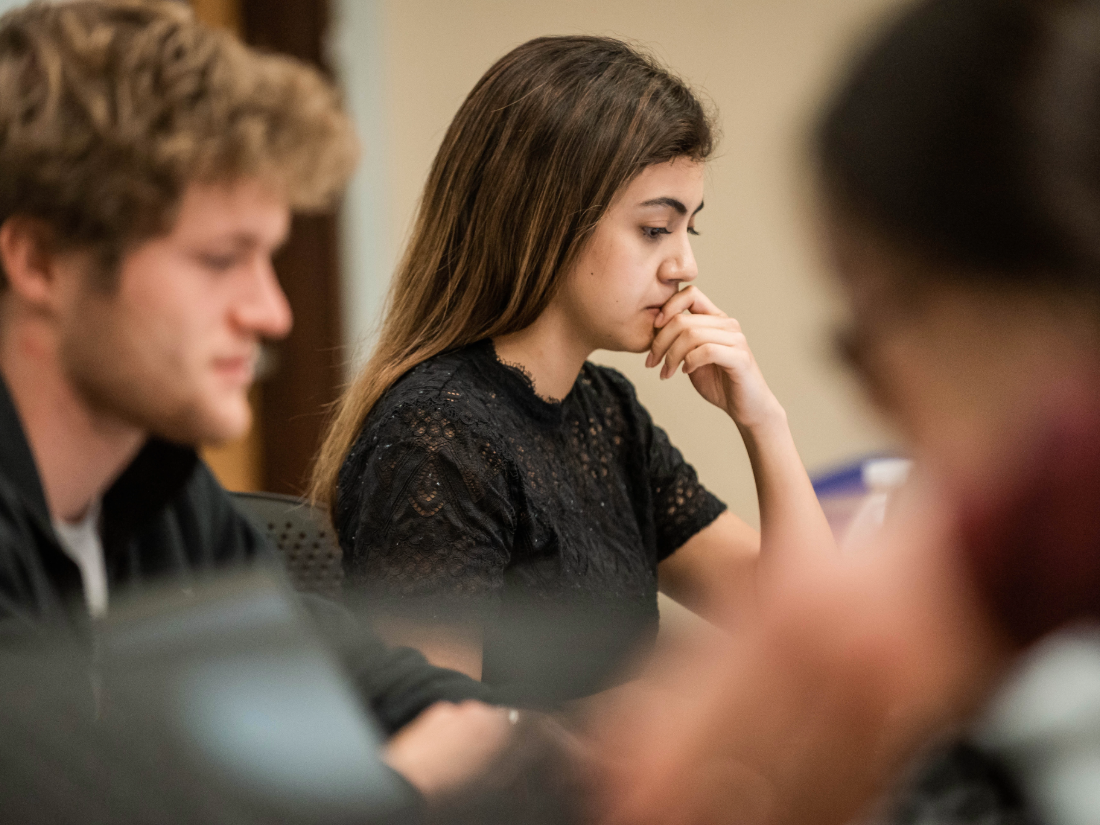
It’s 4:57 on a Friday evening when 100 or so students arrange themselves and their laptops in the tiered rows of CPE 2.208. The building is quiet, except for a couple of soda bottles fizzing open and some crinkling breakfast taco wrappers. Associate Professor Michael Pyrcz ambles up to the whiteboard in his red Chuck Taylors while Associate Professor John Foster double-checks the hackathon GitHub repository and twirls his handlebar mustache.
Hackathon co-hosts Pyrcz and Foster spend the next few hours giving a crash course in Python, a computer programming language often used to analyze and organize large volumes of data. The students in the room, some who have used Python before and others who are brand new to it, will need these coding skills to solve the Hackathon problem — given a challenging multivariate, spatial dataset, where should an energy company drill its next three wells to maximize production?
Fueled by more mountains of breakfast tacos and endless caffeinated beverages, the students will spend the next 36 hours building data science workflows, coding, calculating and recalculating their solutions. If they get stuck, they’ll confer with volunteer mentors from Chevron, Pioneer, ExxonMobil, IBM, ComboCurve and other industry juggernauts who are on site to share their expertise. At the end, each team will present its work to a panel of machine learning experts from companies like Amazon, BP and Dell.
There’s more on the line than bragging rights. The 20 teams — undergraduate and graduate students from engineering, geosciences, business, natural sciences and other programs across campus — are also competing for $9,000 in prize money. Not to mention, there’s the opportunity to connect with industry leaders who could become career mentors and help secure internships and jobs down the road.
But for right now, fingers click-click-click as students type notes about parameters and hyperparameters. Dr. Pyrcz cracks a Bayesian joke, provoking a frequentist retort from Dr. Foster. More soda bottles fizz open. Here we go.
SATURDAY, 9:04 A.M.
Each team settles into the quiet classroom or study carrel they’ve set up as their home base. They plug in their computers and snap off the lids of whiteboard markers.
SATURDAY, 11:22 A.M
Students are knee-deep in the data, evaluating the given information, brainstorming solutions and planning prototypes. Mentors sit with each team to answer questions and help troubleshoot. “The problem is hard, and you’re given a lot of data,” says Ivan Feng (MSPE 2022). “It’s like someone handing you a bunch of lumber and nails and telling you to build a house. Without a plan, you don’t even know where to start. You need to break the problem down into parts that you can combine into a solution.”
SATURDAY, 4:47 P.M.
Coding is in full swing. Dr. Foster explains an AI concept to a couple of students while others revisit their strategies and bounce new ideas off their mentors. Teams test and refine their computer models as the setting sun filters through the Caudle Lounge windows. “After hours of planning, we thought we had an excellent strategy,” says John Eric McCarthy (BSPE 2022). “But we quickly realized there were obstacles we had failed to address. We had to create a new approach on the fly, and the industry mentors really helped us improve our answers.”
SATURDAY, 9:35 P.M.
Most teams are still hard at work. The snack table gets replenished and somebody’s fingers drum a quiet beat on their water bottle. A couple of students turtle into their hoodies and sneak in a quick power nap.
SUNDAY, 10:16 A.M.
The final push. Teams finesse their models, work through last-minute hiccups and practice their presentations. “Besides a cup of coffee, the pressure and deadline kept me focused,” says Lei Liu (MSPE 2020, PhD PE 2024). “We knew we couldn’t give a 100 percent correct answer because there just wasn’t enough time, but we made a presentation we were proud of that showed all the work we had collaborated on over the two days.”
SUNDAY, 1:52 P.M.
Go time. Each team presents their solution in front of the other hackathon participants, the team mentors and the panel of judges. “The final presentation was perhaps the part I personally enjoyed the most because it was a chance to communicate our thought process to the judges,” says Valeria Vallejo (MSPE 2023). “We shared all the work we did, our results, the lessons we learned and what we would do differently next time.”
SUNDAY, 4:30 P.M.
EOF — “that’s a wrap” in Python speak. The HackBros team — Feng, his brother Richard (BSEE 2023, BBA 2023), Tesleem Lawal (MSPE 2020, PhD PE 2024), and Dongyoung Yoon (PhD PE 2023) — win the $5,000 first-place prize. “We were not certain we had the best solution,” Feng says, “but we were certain that our solution was the best we could have produced in the limited time we had.” After the awards are handed out, everyone snags a few leftover breakfast tacos and heads home for a nap, dreaming of salsa and strings of code.