Re-Engineering a Life
Channy Soeur (BSPE ’84) escaped Cambodian tyrant Pol Pot’s killing fields by 24 hours — a blip in geologic time but a life-altering moment in his own history.
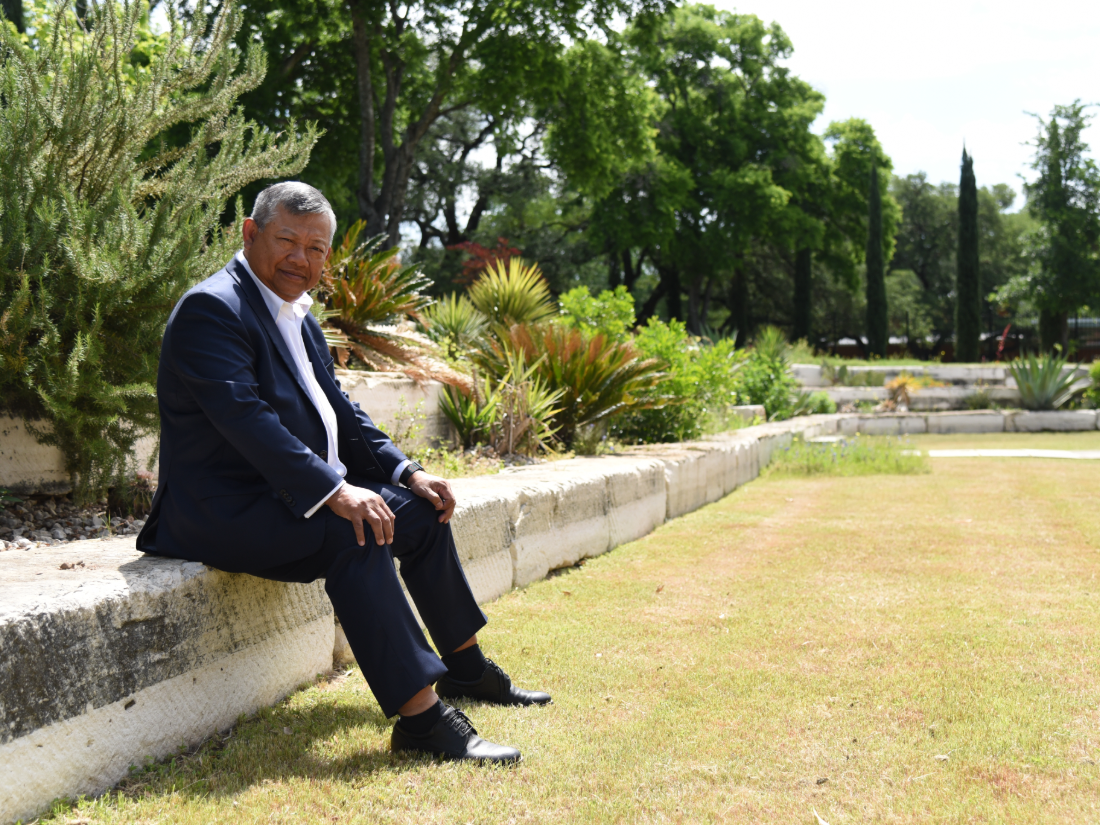
Nearly fatally wounded by a grenade while guarding his high school at age 15, Soeur spent two months in the hospital before enlisting in the Cambodian Navy in the fight against Pot’s Khmer Rouge army. On the eve of the Khmer Rouge’s declaration of victory, Soeur fled with more than 700 others by ship to Thailand, Malaysia and eventually the Philippines. He was 20.
While Pol Pot and his henchmen began a genocide that would ultimately claim the lives of two million Cambodians, including his family, Soeur immigrated to Fort Indiantown Gap, Pennsylvania, in 1975 as one of the first refugees admitted under the Indochina Migration and Refugee Assistance Act. He brought nothing with him except the clothes on his back and a vocabulary of three English words: yes, no and OK. With assistance from local nonprofits, he settled in Providence, Rhode Island, and got a job scrubbing dishes at a seafood buffet near his boarding house.
“I remember crying after my first night on the job. I had been on my feet for over 12 hours without a break. I had no family or friends to go home to, and I realized at that moment just how hard it would be to put my life back together.”
Channy Soeur
But he did it, eventually taking a second job at a coffee factory, earning his GED and enrolling in community college engineering classes before moving to Austin to start work on his BS in petroleum engineering. After graduating, he took a job as a computer graphics technician for the City of Austin and worked his way up over the next decade and a half to assistant director and deputy director of two city departments. In 2001, he
left his job with the city and founded CAS Consulting and Services out of his garage.
Today, CAS has more than 30 employees and offices in five cities. The civil engineering firm specializes in the development, rehabilitation and expansion of urban water and wastewater systems, watershed management, and transportation systems. Soeur and his teams have worked on projects including the City of Austin’s Waller Creek Tunnel project; San Antonio’s largest-ever wastewater tunnel, called the W6 Interceptor; and San Francisco’s Biosolids Digester Facilities Project, which will modernize the city’s existing treatment plants and help them better withstand earthquakes and sea-level rise.
“Fluid mechanics, physical chemistry, thermodynamics — all those classes made it pretty straightforward to use my petroleum engineering degree to do civil projects,” he says. “But my ticket to ride was all the modeling and simulations, the differential equations and linear algebra. Being able to write the programs to develop accurate models gave me a tremendous amount of confidence.”
Some sage and time-tested advice from his former professor, Larry Lake, also came in handy: “Think forward, think backward, and never give up until you solve the problem.”