UT PGE 2012 Distinguished Alumni Honorees
The 2012 Distinguished Alumni weekend honored six outstanding graduates from the department; unveiled a new, technology-focused learning center; and premiered “The Hunt.”
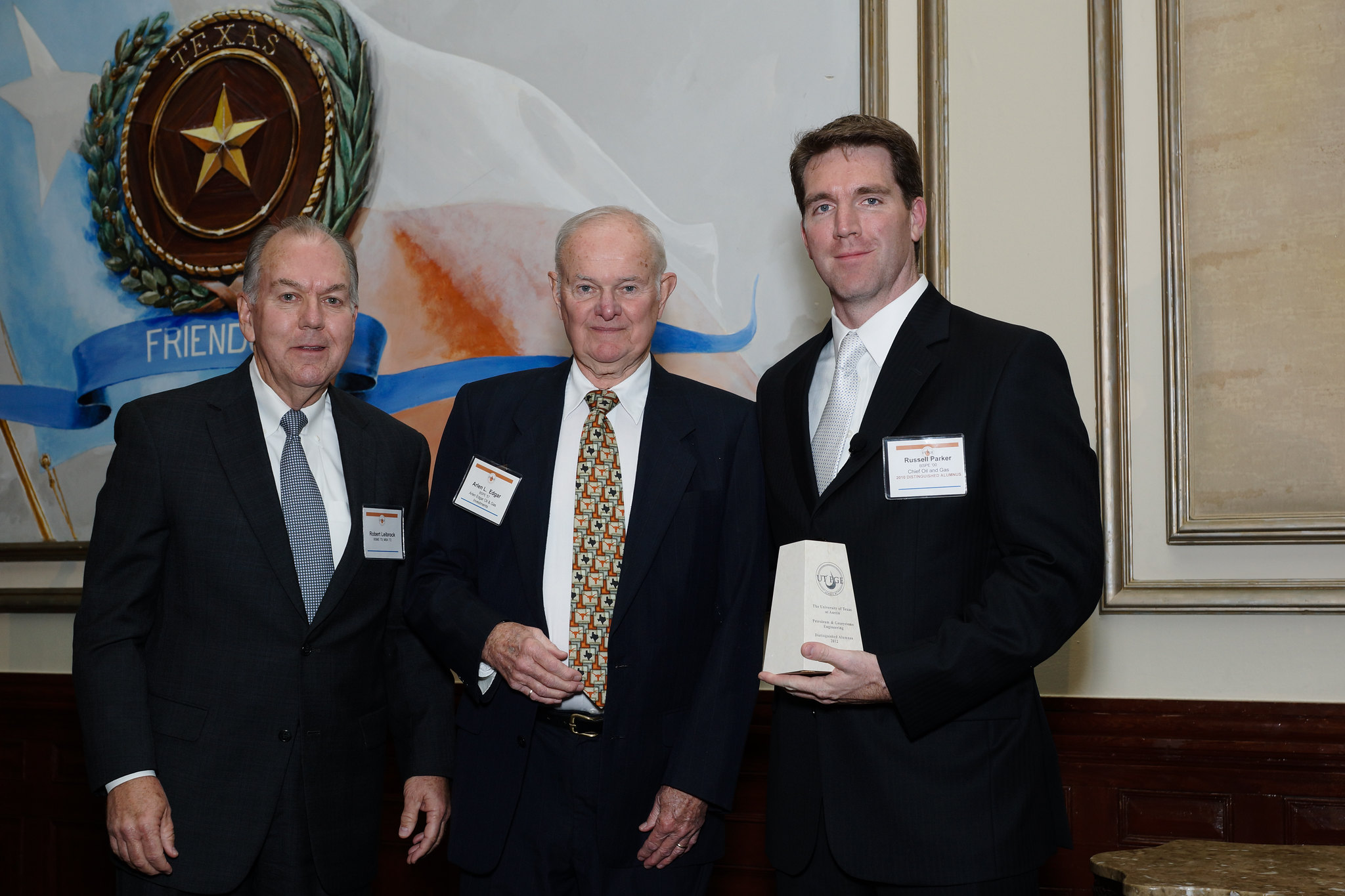
The sold-out Distinguished Alumni Reception and Dinner recognized a deserving group of alumni for their outstanding contributions to the oil and gas industry, shining a light on their technical and business accomplishments, as well as their leadership in promoting the oil and gas industry.
The 2012 Distinguished Alumni honorees included:
James C. “JC” Anderson
B.S., Petroleum Engineering, 1954
James Carl Anderson personifies the entrepreneurial spirit. It’s a spirit that has carried him from the plains of his native Nebraska to the pinnacles of success in the international oil and natural gas industry.
Anderson’s remarkable career—initially as an Amoco Petroleum Corporation engineer executive in the United States and Canada and ultimately as Founder, Chairman and Chief Executive Officer of two energy exploration and development firms in his adopted home of Alberta, Canada—was founded on his petroleum engineering education at UT PGE.
Following graduation with his BSPE degree in 1954, he worked briefly as a roustabout for Amoco in West Texas, then spent two years in military service with the U.S. Army Counter-Intelligence. He returned to Amoco in 1956, launching his business career. Over the next dozen years, he worked as a petroleum engineer in Texas, Louisiana, Oklahoma, Colorado and Canada, rising in 1966 to the post of chief engineer for Canada at Amoco.
In 1968, he founded Anderson Exploration, Ltd., an oil and gas exploration and production company based in Calgary, Alberta. For more than 30 years, he served as the firm’s Chairman and CEO. In 1970, Anderson (sole owner at the time) was responsible for the discovery of the huge Dunvegan Gas Field in northern Alberta, which has produced over one trillion cubic feet of gas and is expected to produce for years to come.
With Dunvegan, a cornerstone property, Anderson Exploration grew steadily through both development and acquisitions to become Canada’s fifth largest natural gas producer, with operations ranging from the Beaufort Sea to Manitoba. It went public in Canada in 1988 and was listed on the New York Stock Exchange in 2001. That same year, it sold for $4.6 billion to U.S.-based Devon Energy.
Ever the entrepreneur and an indefatigable engineer, Anderson established a new entity, Anderson Energy, a year later. He presently serves as Chairman of this latest venture. He was named Prairies Canada Master Entrepreneur of the Year in 1996 and received the 2000 Canadian Society of Petroleum Geologists’ Stanley Slipper Award for outstanding petroleum exploration. Today, Anderson enjoys spending time with his family on his ranch south of Calgary. He keeps his ties to UT PGE strong by supporting scholarships for outstanding transfer students from Southern Alberta Institute of Technology Polytechnic to complete a petroleum engineering degree at UT PGE.
Kermit E. Brown
M.S., Petroleum Engineering, 1959
Ph.D., Petroleum Engineering, 1962
“Teaching has been my main objective most of my life,” said Dr. Kermit Brown during his recognition as a Legend of Production and Operations in the SPE Journal of Petroleum Technology in 2009. “It is something that I have enjoyed more than anything else I have done.”
Known internationally as a leader in artificial lift technologies and a pioneer of the industry-supported research consortia model in the petroleum engineering discipline, Brown enjoyed a long career in academia as well as service to the Society of Petroleum Engineers.
After completing his WWII service as a pilot, Brown attended Texas A&M University, graduating with a double major in Petroleum and Mechanical Engineering in 1948. He began working for Stanolind Oil & Gas in Louisiana before beginning his graduate studies in petroleum engineering at UT PGE. A contemporary of fellow UT PGE Distinguished Alumnus Dr. Ben Caudle, Brown joined the UT PGE faculty as an assistant professor in 1955, and became associate professor before moving to Tulsa in 1966 to become professor and chair of the Petroleum Engineering Department at The University of Tulsa. Later in his career, he became Associate Dean of the College of Engineering and Physical Sciences, and eventually Vice President of Research and Chairman of the Resources Engineering Division.
When he joined the TU Petroleum Engineering faculty, Brown faced a department with only three full-time faculty, 50 undergraduate students, and a fledgling doctoral program with no research funding. Brown’s leadership over the years resulted in the development of one of the earliest industry research consortia in petroleum engineering—focused on drilling technologies—which grew from just a handful of companies to over 10 different consortia conducting millions of dollars of research every year. Brown also established TU’s Honors Petroleum Engineering undergraduate program and one of the earliest high school recruiting outreach programs in the engineering world. Again, Brown secured industry support for scholarships and internships while presenting with other TU faculty at some 50 high schools throughout northeastern Oklahoma.
Among his many publications on gas-lift technology, Brown was most well known for his book, The Technology of Artificial Lift Methods–Volume 4: Production Optimization of Oil and Gas Wells by Nodal Systems Analysis, as one of the most important efforts in which he was involved. The book is still being used by the industry as well as by many students.
Brown was an active SPE member from the 1960s, serving on numerous committees and eventually the SPE Board of Directors during 1970–71. Brown’s many honors include the SPE John Franklin Carll Award and SPE Distinguished Member in 1983, and SPE Honorary Member in 1990. He was inducted into the National Academy of Engineering in 1987, the year he retired from his faculty position at Tulsa. Dr. Kermit Brown passed away in 2009; he was followed by his wife, Katherine, in July 2012 and is survived by his daughter, Sandi Kay and three sons, Stephen, Michael and David, as well as eight grandchildren and four great-grandchildren.
Varadarajan “DW” Dwarakanath
M.S., Petroleum Engineering, 1992
Ph.D., Petroleum Engineering, 1997
Varadarajan “DW” Dwarakanath was born on April 30, 1970, in Bombay (now Mumbai), India, to Champa and K. Varadarajan. His grandparents on the maternal side were Rajalakshmi and Govindarajan, and on his paternal side were Rajalakshmi Ammal and Krishnasami.
Soon after his birth, his parents relocated to New Delhi and began his education at the age of only three. His mother, Champa, a highly motivated parent with a talent for teaching, inspired DW to excel academically throughout his primary education. He excelled in math and history, while his mother prompted a rigorous course of 18th and 19th century English literature, including a great number of Charles Dickens’ novels. By the time of his 10th-grade board exams in 1984, DW ranked 27th out of 70,000 nationally in India, including the highest score in English and the second-highest in Sanskrit, and went on to major in science during his final two years in high school. DW tackled the Mining Engineering program at the Institute of Technology, Banaras Hindu University, graduating with a B. Tech in Mining in 1990. A family friend in Yemen encouraged DW to consider petroleum engineering as a career, and he suggested only one school: UT PGE. DW completed his M.S. in petroleum engineering under Dr. Martin Chenevert in 1992, followed by his Ph.D. under Dr. Gary Pope in 1997.
DW began his professional career at Austin-based INTERA as Senior Geoscientist in March 1997. During his time at INTERA, DW became known for his expertise in environmental contaminant identification and remediation strategies. But his passion lay in the energy industry, and the innovative EOR applications Chevron was developing with Dr. Pope at UT PGE motivated him to relocate to Houston and join Chevron in 2005.
In just six months, DW rose from Reservoir Simulation Engineer at Chevron into the EOR group within Chevron Energy Technology Company as a lead Reservoir Engineer. In 2008, he assumed his current role as Team Manager for Reservoir Performance and Characterization, where he helps Chevron implement emerging EOR technologies in mature fields. Under DW’s leadership, the company has one published patent and several more patent applications under consideration, as well as 18 peer-reviewed technical publications on a wide range of surfactant flooding and tracer research applications for EOR research applications.
He married Sumitra Subrahmanyan in May 2006 and has two daughters: Kritika, age 4, and Malavika, age 1. He lives in Houston, TX with his wife, two daughters and his father.
Arlen Edgar
B.S., Petroleum Engineering, 1957
Arlen Edgar, a native of Stephenville, Texas, earned his bachelor’s degree in petroleum engineering from The University of Texas at Austin in 1957 after receiving an associate degree in engineering from Tarleton State University.
Edgar began his career with Pan American Petroleum in Odessa, then moved to Midland to serve as junior and intermediate engineer. After three years in Midland, Pan American asked Arlen to move to Fort Worth. Leibrock, Landreth, Campbell and Callaway (LLC&C) consulting engineering firm offered him a job as well. He accepted the job and remained there six years, becoming manager of the consulting division. At the same time, he served as secretary and a director of Canada-based Kanata Exploration and southern Louisiana-based Offshore Exploration Company.
In 1967, Edgar joined Robert M. Leibrock’s new company, Tipperary Land and Exploration, which was involved in farming, cattle, shrimp fishing, hard minerals – but no oil. He spent time exploring Australia, discovering a major bauxite deposit there. He later served as president of the Society of Petroleum Engineers.
After four years with Tipperary, Edgar joined Western States Producing Company as general manager of the San Antonio-based company’s Midland office. After spending two years there, he decided to branch off as an independent investor and consultant. He now spends his time investing in drilling deals, while also staying involved with professional organizations and community and church activities in Midland.
Edgar has been recognized as a distinguished alumnus of Tarleton State University as well as a Distinguished Engineering Graduate of UT Austin’s Cockrell School of Engineering. He has received many awards from organizations such as the Society of Petroleum Engineers, the American Institute of Mining, Metallurgical, and Petroleum Engineers, the Society of Petroleum Evaluation Engineers, and the Society of Independent Professional Earth Scientists, as well as various other recognitions for his many achievements. Among these were the Top Hand Award from the Permian Basin Petroleum Association and the Hearst Energy Award for Lifetime Achievement from the Midland Reporter-Telegram.
Edgar currently resides in Midland, where he operates as an independent investor under his name.
Stephen E. Skinner
B.S., Petroleum Engineering, 2001
Born in Greenville, South Carolina, “Steve” Skinner’s family moved to Texas when he was three years old. Although his father’s career as a civil engineer at the South Texas Project Electric Generating Station exposed him to engineering from an early age, it was a conversation with former UT PGE professor Dr. William Rossen about the challenges of finding hydrocarbons that inspired Skinner to enroll at UT PGE. He received his BSPE from The UT Austin in 2001. During his time at UT PGE, he was the President of the Society of Petroleum Engineers student chapter, as well as the SPE representative to the Student Engineering Council.
After graduation, Skinner started his career with Phillips Petroleum, later ConocoPhillips, and worked on many of the company’s Lower 48 assets. There, he rotated through various assignments in reservoir, production, and drilling engineering, applying the fundamentals of his UT PGE engineering education. When the Fayetteville Shale play in Arkansas began to take off, Skinner moved to Southwestern Energy and helped that company complete some of the first multi-stage horizontal wells in the play. He parlayed these experiences into a new shale development leadership position with Edge Petroleum.
Although these experiences were invaluable to him, Skinner felt the entrepreneurial calling and, in 2008, was a cofounding partner of the first of three new companies bearing the name Ursa Resources.
The first Ursa was a group of young professionals who decided to “bootstrap” and start their own company. The company successfully sold prospects before deciding to concentrate its efforts on entering the emerging Bakken play in the Williston Basin. During the first iteration of Ursa, he also started Skinner Consulting, through which he was involved in engineering and completing some of the first horizontal wells in the Eagle Ford formation in Texas.
With the second company, Ursa Resources Group LLC, Skinner acted as Vice President of Development, managing the planning & development of the company’s 120,000 acres in the Bakken play in Montana and North Dakota, as well as the design and implementation of hydraulic fracturing operations. The company successfully drilled and completed multi-stage horizontal wells before successfully divesting the assets.
Today, Skinner is the Chief Operating Officer of Ursa Resources Group II LLC in Houston, Texas. The third company to bear the Ursa appellation actively explores domestically for frontier liquid hydrocarbon plays to drill while also acquiring natural gas-producing properties.
Skinner resides in Houston, TX, with his wife, Myra and their daughter, Sarah Paige. He is a registered professional engineer in the state of Texas. Skinner enjoys running and has completed several marathons. He is a member of SPE, IPAA, and a lifetime member of the Texas Ex-Students Association. He and his wife are proud supporters of Friends of Alec and the Longhorn Foundation.
Joe C. Walter, Jr.
B.S., Petroleum Engineering, 1949
M.A., Geology, 1951
Joseph Charles Walter, Jr., or Joe as he was widely known, was a Houston native, the son of Gladys Hoskins and Joseph Charles Walter, Sr., an oil and gas landman. Born in 1927, he completed Lamar High School and graduated from UT Austin with his B.S. in petroleum engineering in 1949 and an M.A. in geology in 1951.
Walter’s career began right out of college in the form of an apprenticeship with Jersey Standard/Humble, where he applied his petroleum and geology education towards evaluating oil reserves. He met and soon married Elizabeth Cowden (UT B.S. Elementary Education, ’51), of Midland, and began his family.
In 1957, after daughter Carol Walter Looke and son J. C. Walter III (Rusty) were born, Joe set up shop in association with his father’s business, Houston Royalty Company. After the passing of Joe Sr. and his partner Irwin Smith, Joe Jr. and his partners bought a controlling interest in, and later merged with, Royalties Management Co. from Tulsa. This led to the creation of Houston Oil and Minerals.
Houston Oil and Minerals went public in the late 1960s, developing a major gas play in the Frio of Galveston Bay, growing soon to a number of international projects ranging from the North Sea to Africa, the Middle East, South America and Australia. Houston Oil and Minerals included a substantial coal business as well, eventually growing to have the fourth largest mineral position in the US. Before negotiating a merger with Tenneco in 1981, Walter built Houston Oil and Minerals from a start-up to a 1400-employee company with five divisions.
After a heart transplant at Methodist Hospital performed by Dr. Jimmy Howell, Walter took two years off but soon found himself forming another company in 1983, Walter Oil and Gas. During this time, he also served as the President of the Petroleum Club in Houston. Between that time and his death on June 14, 1997, Joe continued his business interests with Walter International and Walter Oil and Gas International.
Beyond his business interests, Walter was a major force behind Houston’s Methodist Hospital and Methodist Health Care system, and St. Luke’s United Methodist Church. He loved to hunt birds on his ‘farm’ near Brownwood and was an avid woodworker. Joe received many honors from The University of Texas at Austin, including: Distinguished Engineering Graduate, 1977; Distinguished Geology Graduate, 1984; Texas Exes Distinguished Alumnus, 1985; College of Natural Sciences Hall of Honor, 1995; and Geology Hall of Distinction, 2006.
Thanks to all our underwriters and sponsors, it was a night to remember with generations of alumni and current students in the Driskill ballroom connecting on past experiences and creating new memories. The room was full of optimistic energy about the department and the industry. Visit the DA Reception and Dinner set on Flickr to view the candid shots from the evening.
The Tailgate and Reunion following the Distinguished Alumni Program included two milestone moments for UT PGE: The ribbon-cutting ceremony for the Ben H. Caudle Student Learning Excellence Center and the premiere of the department documentary.
More than 120 people, including the stars of the film, packed into a classroom to see the documentary on the big screen. “The Hunt” showcased the strong history of the department and how it truly changed the world, while also taking the audience through the journey of a current student and a father-son entrepreneurial alumni team looking to strike it big in the Canadian oil fields. For a sneak preview of the film, view the trailer on YouTube. Information about screening the full documentary will be available early next year.
The other landmark moment was honoring a professor emeritus with a state-of-the-art learning resource center. Dr. Caudle cut the ribbon, unveiling the new space surrounded by his dedicated former students, who brought the effort to fruition. During his tenure at UT PGE, Dr. Caudle’s passion was teaching students and ensuring maximum learning – that tradition will carry on through the center. The students have already nicely settled into the space and are enjoying the technology capabilities and natural light.